Special report · BisCoM22May 25–31, 2026ISSN 0121-4675Year 36 · 1991–2026
Series "Open Veins of the Colombian Health System"
Nine trillion pesos in ten years, and nobody is counting them
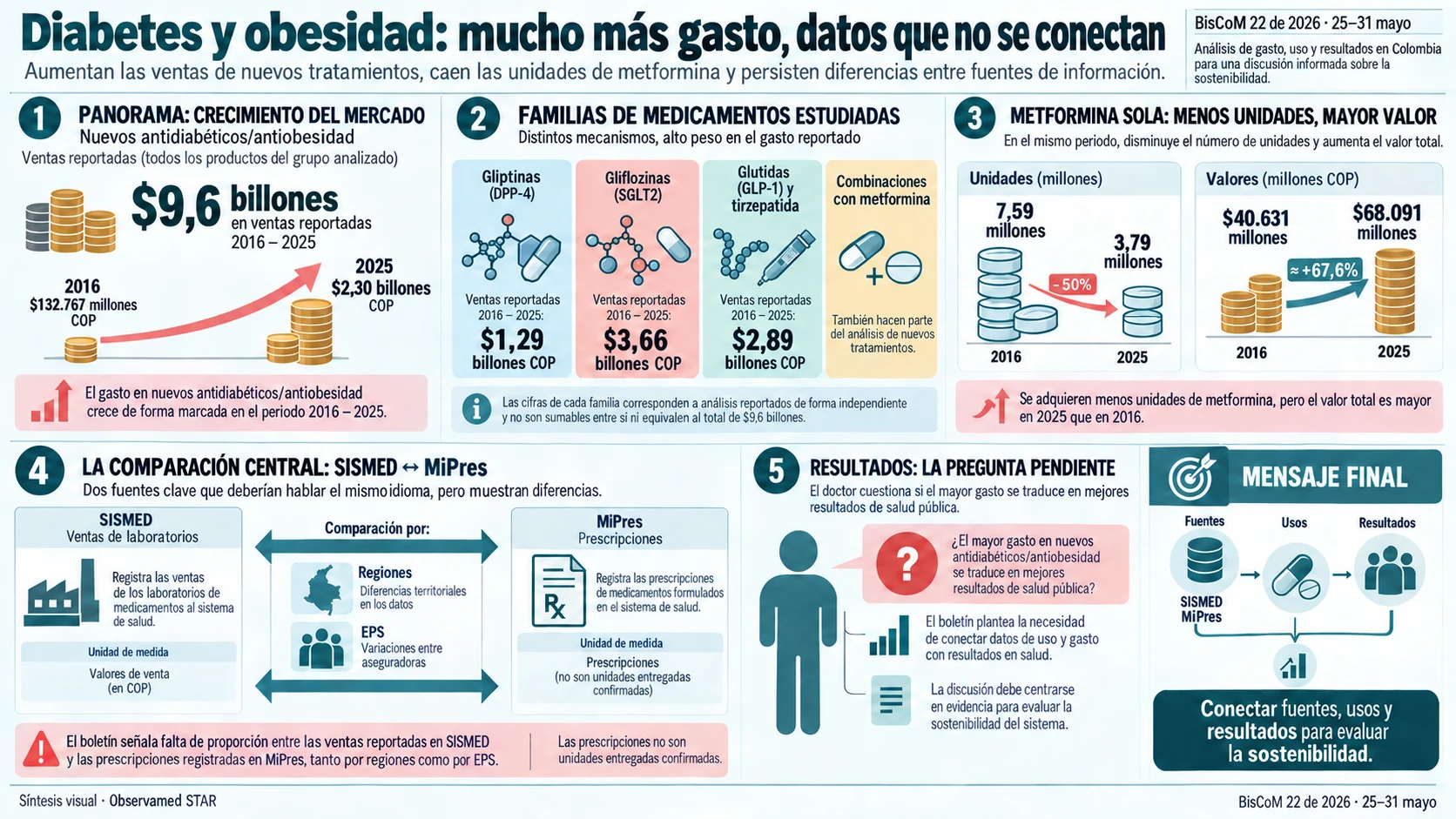
Between 2016 and 2025, pharmaceutical companies reported sales of 98 million units
of new medicines for type 2 diabetes and obesity, worth COP 9.6 trillion.
The problem is not just how much. It is that those sales do not match the registered medical prescriptions.
Dr. Óscar Iván Andía Salazar
Medicines Informatics, Health and Consumer Bulletin · Updated May 30, 2026
$9,6 trillionSold in ATC4-A10B group medicines between 2016 and 2025
98 millionOf units reported to SISMED over those ten years
17×Annual spending grew: from COP 132,767 million in 2016 to COP 2.3 trillion in 2025
−50%Units of metformin alone, the first-line treatment, fell
The essentials
What matters, in six points
The new medicines for type 2 diabetes and obesity —gliptins, gliflozins, glutides, and tirzepatide— moved COP 9.6 trillion in ten years.
Annual spending rose from COP 132,767 million in 2016 to COP 2.3 trillion in 2025. Seventeen times higher.
Only the GLP-1 agonists (Victoza, Saxenda, Trulicity, Ozempic, Mounjaro) add up to COP 2.9 trillion.
The central finding: sales reported to SISMED are not proportional to the prescriptions recorded in MiPres. Neither by region nor by EPS.
Meanwhile, metformin alone —the first-line treatment, inexpensive and proven— fell by half in units but rose in money spent.
The bulletin's conclusion: "without changes in the analysis of sources, uses and health outcomes, financial sustainability is impossible".
The total
Where the COP 9.6 trillion went
The entire ATC4-A10B group, according to the pharmaceutical companies' own reports to SISMED between 2016 and 2025.
GLP-1 agonists · A10BJ
COP 2.9 trillion 12,267,049 units. Liraglutida, dulaglutida, semaglutida and tirzepatida.
Gliflozins · SGLT2 · A10BK
COP 3.6 trillion 33,296,640 units. Dapagliflozin, canagliflozin, and empagliflozin.
COP 2.7 trillion 45,012,398 units. Metformin mixed with the new molecules, at the price of a new molecule.
From COP 132,767 million a year to COP 2.3 trillion a year.
In 2016 the whole group sold 2,198,588 units. In 2025 it sold 18,358,804.
Eight times more units, but seventeen times more money: it is not just that more is being prescribed,
it is that what is being prescribed is much more expensive.
The finding
Sales do not match prescriptions
This is what the bulletin repeats product by product, and it is the most serious point in the whole document.
What is sold
SISMED
Medicine Price Information System
Laboratories are required by law to report here what they sell: units and values, quarter by quarter.
Records primary transactions of those who import or produce
It is the source of the figures in this bulletin
Public database of the Ministry of Health
What is prescribed
MiPres
Prescription platform
Records the medical prescriptions for medicines that are NOT in the benefits plan. It is mandatory.
Lets you see the prescription by region and by EPS
Almost all of these new molecules go through here
Metformin does not appear: since it is in the benefits plan, it is not recorded
The bulletin says it about one product after another, without exception:
"The laboratory's sales reports are not proportional to the medical prescription reports on the MiPres platform, either by region or by EPS."
Put simply: far more is being sold than appears prescribed. Either the sales reports are inflated, or there are medicines circulating without a prescription to back them. Either possibility is serious, and neither can be resolved without an information system that cross-checks the two sources. That is exactly what the observatory has been asking for with the SITDIS.
The contrast
Is metformin being abandoned?
The bulletin itself asks the question. The numbers are uncomfortable.
7.591.899Units of metformin alone sold in 2016
3.787.465Units sold in 2025. Half.
$40.631 MWhat that volume cost in 2016
$68.091 MWhat half the volume cost in 2025
Half as much metformina was sold and 68% more was paid.
The bulletin attributes this to the higher price of «retard» forms and commercial brands,
«with the perception of better quality».
And there is a detail worth understanding: metformin does not appear in MiPres.
Because it is included in the benefits plan, it does not require a prescription record.
In other words: the cheapest and best-proven medicine is precisely the one that can be monitored the least.
Who
The laboratories and their brands
These are the products the bulletin analyzes one by one, with a chart of annual sales. The names come from the public reports to SISMED.
The bulletin also records vildagliptin from Merck (Jalra), Willow (W-Liptina) and Adium (Vilzer), and sitagliptin from Genfar.
A separate case
The alogliptin case
Here the bulletin does not find an excess. It finds a gap.
Takeda's alogliptin has no sales reports in SISMED, nor prescriptions in MiPres.
Neither the laboratory nor the importers reported sales of Nesina 12.5 mg.
And there is not a single prescription registered on the platform either.
The question the bulletin leaves is direct: if there are no reported sales and no prescriptions,
is the medicine available in the country or not? A valid marketing authorization (registro sanitario) with no
trace of circulation is, in itself, an inconsistency worth looking into.
Full materials
The data, active ingredient by active ingredient
The bulletin publishes one PDF for each molecule, with the complete sales series. All of them are open.
Disclaimer. The information published here is provided as a service to health professionals and their patients. It is in no way intended to suggest treatments or to replace the doctor-patient relationship. No staff member of Fundación Observamed STAR, Med-Informática Editores S.A.S. or Medicentro AR S.A.S. can accept any responsibility for improper use of the information published on these pages.