








Series "Open Veins of the Colombian Health System"
Pharmaceutical sovereignty: good diagnosis, half-implemented
Colombia imports 7 out of 10 medicines that it consumes. To change that there is a law,
a CONPES, and COP 1.37 trillion committed through 2035.
Here is what they promise, where the money goes, and why—almost two years after the law—
Observamed considers that what has been achieved is partial and insufficient.
Dr. Óscar Iván Andía Salazar
Medicines Informatics, Health and Consumer Bulletin · Updated June 24, 2026
70%Of the medicines Colombia consumes, these are imported
8×Colombia imports eight times more than it exports in pharmaceutical products
$1,37 trillionCONPES 4170 investment between 2026 and 2035
6,01Benefit/cost ratio of the project in the base scenario
The essentials
What matters, in six points
Law 2386 of 2024 declares the pharmaceutical sector strategic for the country and orders that what is now imported be produced domestically.
CONPES 4170 of 2025 provides the funding: COP 1.37 trillion between 2026 and 2035.
The diagnosis is harsh: of 6,090 marketing authorizations to manufacture and sell, only 12 —0.2%— belong to State entities.
Both documents diagnose the problem well. Observamed expressly acknowledges this.
But the law has gone almost two years without being regulated and implementation of the CONPES, about to turn one year old, is still partial.
The proposal: start with the information system —SITDIS—, because without data there is no way to monitor anything.
How we got here
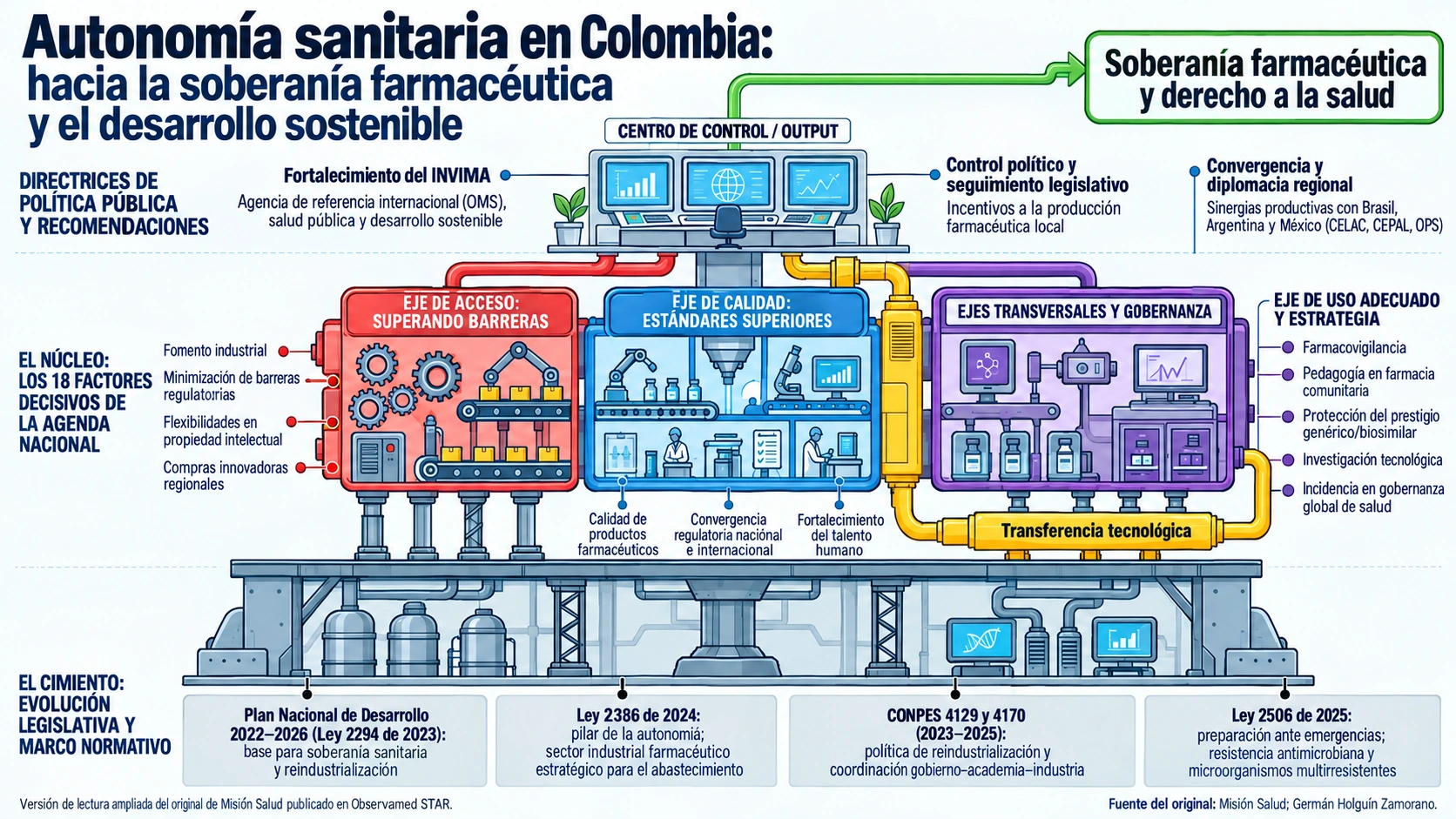
Twelve years in a single line
From a strategy written in 2014 to a ten-year national plan.
The 18 decisive factors of the national agenda, its four axes and the regulatory framework that supports it. If you want to view it at leisure, tap the image to enlarge it.
Source: Misión Salud brochure. Source of the vision: Germán Holguín Zamorano, Misión Salud and academic stakeholders. Published in the BisCoM21 bulletin of Observamed STAR.
What both have in common
Three objectives and four key points
Both documents point to the same goal. Here is what they seek and how they intend to achieve it.
Main objectives
01 · Reduce dependence
Reduce Colombia's dependence on imports of medicines, active ingredients and raw materials.
02 · Ensure supply
To prevent shortages of essential medicines and health technologies in future emergencies or public health crises.
03 · Stimulate local industry
Encourage domestic production with high standards of quality, safety, and efficacy.
Key points
Scope of application
It applies to all scientific, regulatory, promotion, production and marketing activities in the pharmaceutical sector.
Financing and incentives
Health Research Fund (FIS), tariff benefits, development loans, and financial support for scientific personnel.
Cooperation and transfer
International alliances and technology transfer to train specialized human talent in science and health.
Institutional coordination
Requires joint work by MinSalud, MinCiencias and INVIMA with academia and the private sector.
MedInfoGrafía
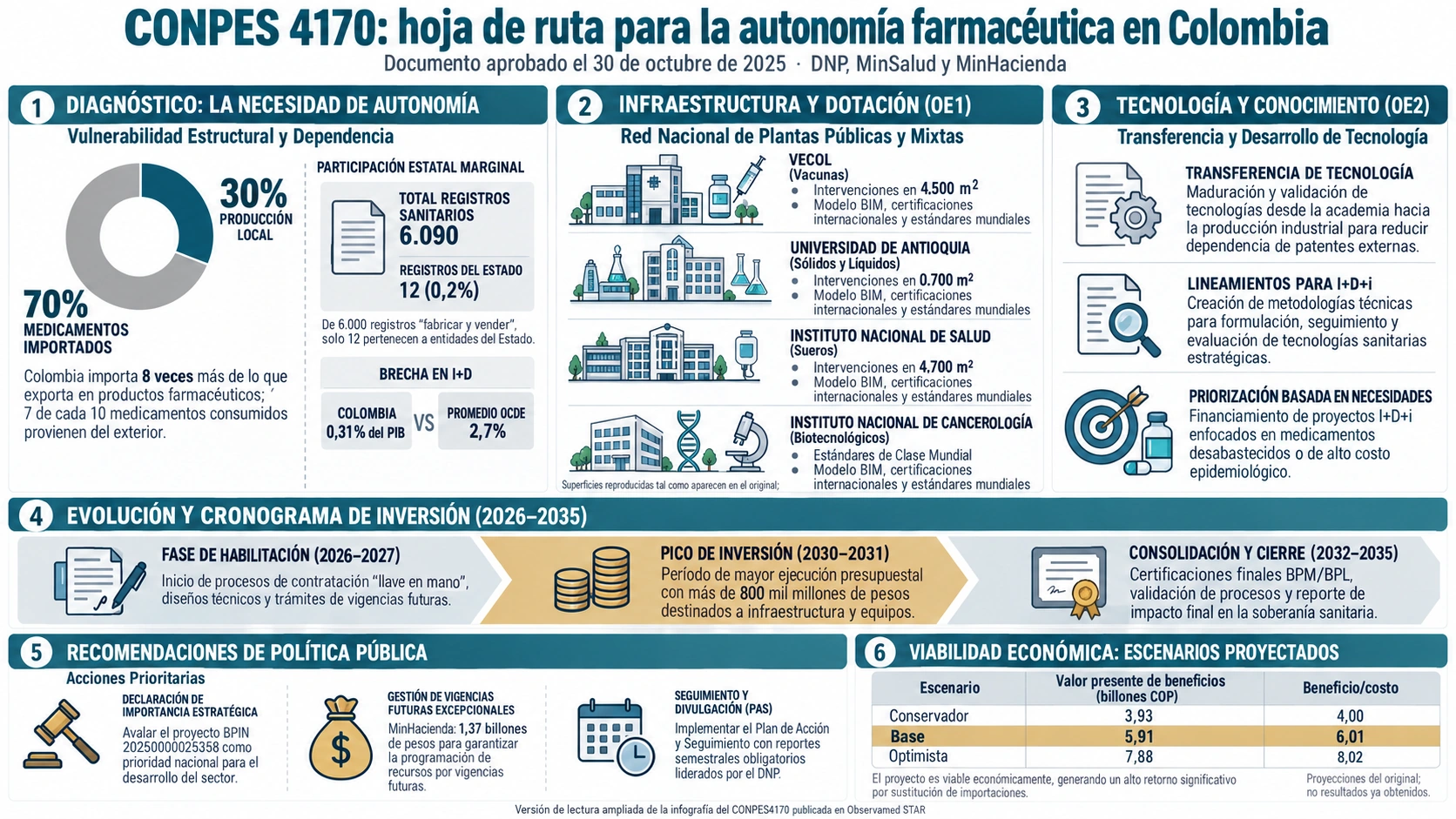
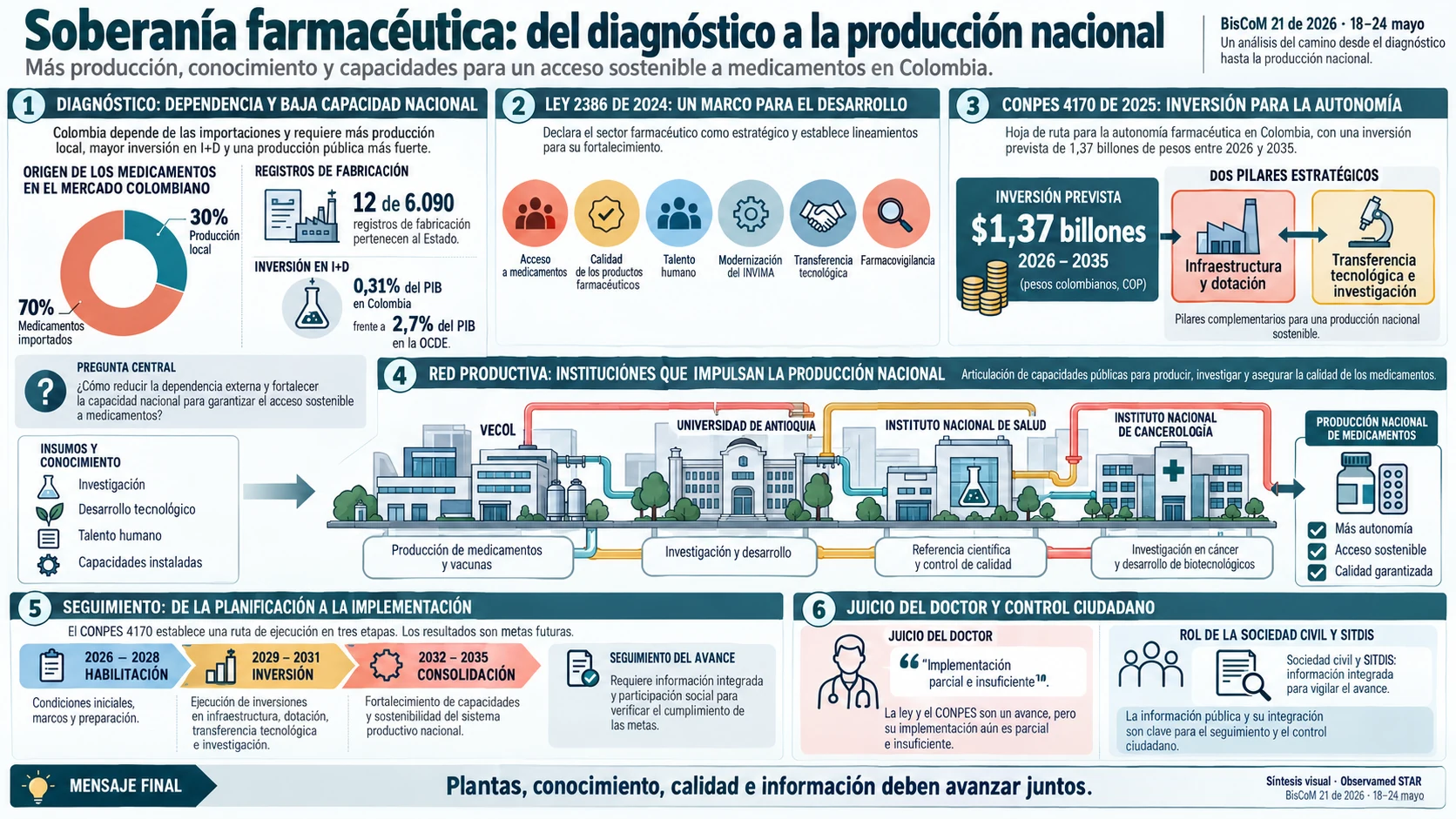
CONPES 4170, in a single table
The diagnosis, the two strategies, the timeline and the project's profitability. If you want to look at it carefully, tap the image to enlarge it.
CONPES document approved on October 30, 2025. Authors: National Planning Department (DNP), Ministry of Health and Social Protection, and Ministry of Finance and Public Credit. Infographic published in the BisCoM21 bulletin.
Department
70% of the medicines consumed are imported. Colombia imports 8 times more than it exports.
State participation
Of 6,090 marketing authorizations (registros sanitarios) to manufacture and sell, only 12 belong to State entities. That is 0.2%.
R&D gap
Colombia invests 0.31% of GDP in research and development. The OECD average is 2.7%.
Social return
In the base scenario, the present value of the benefits is COP 5.91 trillion, with a benefit/cost ratio of 6.01.
Progress and timeline
How the ten years break down
Three stages between 2026 and 2035. Most of the investment arrives around the midpoint.
2026 – 2027
Enablement phase
Start of «turnkey» contracting processes, technical designs, and future-appropriation procedures.
2030 – 2031
Peak investment
Period of highest budget execution, with more than COP 800 billion allocated to infrastructure and equipment.
2032 – 2035
Consolidation and closure
Final GMP/GLP certifications, process validation, and final impact report on health sovereignty.
What infrastructure it lands on
Vecol · Vaccines
Interventions covering 4,500 m², BIM modeling, international certifications, and world-class standards.
U. de Antioquia
Solids and liquids. Interventions across 700 m² with BIM modeling and international certifications.
National Institute of Health
IV fluids. Interventions across 4,700 m² under world-class standards.
Natl. Cancer Institute
Biotechnology products, under world-class standards. And district projects such as Bogotá Bio.
Observamed's take
What Observamed thinks
This is the bulletin's opinion, and we want to state it as such: it is an interpretation, not official data.
“Notable in its diagnostic components and its proposals. But its regulation and implementation are partial and insufficient.”
DiagnosisBoth documents identify the problem and its causes well.
RegulationAlmost two years after Law 2386, it still has serious problems.
ImplementationPartial and insufficient, even counting CONPES 4170.
The bulletin's conclusion is not to stop at criticism: civil society organizations
have an obligation to contribute, and the proposed starting point is the design of the
Integrated Transactional and Distributed Health Information System (SITDIS).
Without reliable information, no control is possible.
Full presentation
CONPES 4170 in 13 slides
Tap any of them to enlarge it. You can move through them with the keyboard arrow keys.
Full materials
If you want to go deeper
All the original bulletin material, in the format of your choice.
The basic APP-I version of the
VMI-CFN System
aims to reveal inconsistencies in reports to SISMED and to give health professionals
objective criteria for negotiating prices. Access is free during the first month.
Our special reports
BisCoM22 Special report · Antidiabetics and anti-obesity drugs
Evidence of billions in spending on medicines, without control and with poor public health results.
How much of that problem do Law 2386 and CONPES 4170 solve?
Disclaimer. The information published here is provided as a service to health professionals and their patients. It is in no way intended to suggest treatments or to replace the doctor-patient relationship. No staff member of Fundación Observamed STAR, Med-Informática Editores S.A.S. or Medicentro AR S.A.S. can accept any responsibility for improper use of the information published on these pages.