Judicial monitoring · Council of State (Consejo de Estado)
The Council of State (Consejo de Estado) ruling on medicine prices
The Council of State (Consejo de Estado) confirmed that the State violated collective rights through failures in price policy, oversight and medicine supply, and ordered the creation of a new national pharmaceutical policy. Here we explain what it says, what it orders and how compliance is progressing.
We publish our reading of the ruling: an infographic, the orders that remain in force for each entity, what the decision gets right, the risks to its being carried out, and a feasibility forecast. The full analysis can be downloaded as a PDF.
The Council of State (Consejo de Estado) issues the second-instance ruling
Confirms the 2024 ruling, adjusts the working group order (the policy may be adopted in a CONPES or another suitable instrument), and creates a compliance verification committee.
The case in a threadThe tutela (constitutional injunction), message by message
In 2019, the Office of the Inspector General (Procuraduría) sued the State through a class action (acción popular): according to the lawsuit, medicine price controls cover a very small part of the market and the rest is hardly monitored (pp. 2-5).
Sued the Ministry of Health, the Ministry of Commerce, the National Commission on Medicine Prices, the National Health Superintendency (Supersalud), and the Superintendency of Industry and Commerce; INVIMA, ADRES, and the Comptroller General's Office were later joined to the case (pp. 1, 10-11).
The Medical College of Cundinamarca and Bogotá joined the case as a supporting party in March 2024 (p. 11).
On December 12, 2024, the Administrative Tribunal of Cundinamarca found three proven problems: failures in price policy, in oversight and control, and in medicine supply (pp. 12, 15).
The national pharmaceutical policy (CONPES 155 of 2012) expired in 2021 and no new one was shown to exist. For that reason the Tribunal ordered a working group to build one (pp. 12, 45-47).
The Ministry of Health, INVIMA and the superintendencies appealed. On September 17, 2026, the Council of State (Consejo de Estado) confirmed almost the entire ruling (pp. 1, 70-73).
Only one thing changed: the new policy may take the form of a CONPES or another suitable legal instrument (pp. 53, 71).
And it added something that was missing: a committee to oversee compliance with the ruling, chaired by the Tribunal magistrate (p. 73).
One of the nine topics the roundtable must study is a price data system that, under the SISMED model, is public, reviewable and dynamic (p. 72).
What comes next: forming the working group within the month following notification, setting up the verification committee and receiving the Ministry's progress reports. We will report each step here (pp. 72-73).
To understand itThe ruling in plain words
The Office of the Inspector General (Procuraduría) sued the State because, as it stated, medicine price controls in Colombia cover only a small share of products and the rest is hardly monitored. It claimed this raises public procurement costs and what people pay out of pocket (pp. 4-5, 7).
The Administrative Tribunal of Cundinamarca partly agreed with the plaintiffs on December 12, 2024: it found three proven problems, failures in price policy, in oversight and control, and in medicine supply (p. 15). It ordered the creation of a working group to build a new national pharmaceutical policy, because the previous one (CONPES 155 of 2012) ceased to be in force in 2021 (pp. 12, 45, 47).
Several entities appealed. The Council of State (Consejo de Estado) upheld almost everything, corrected one point (the new policy does not have to be a CONPES document: it may be adopted through another suitable legal instrument) and added what was missing: a committee to oversee compliance with the ruling (pp. 57, 70-73).
Second instance, September 17, 2026What the Council of State (Consejo de Estado) decided
Modifies
Working group for a new pharmaceutical policy
The working group led by MinSalud, the CNPMD and INVIMA continues, with the same participants and nine points of study. The policy may take the form of a CONPES or another suitable legal instrument. It must be established within the month following notification; MinSalud chairs it and submits progress reports to the magistrate (pp. 71-72).
Adds
Compliance verification committee
New. It is chaired by the reporting judge (magistrado sustanciador) of the Tribunal and is made up of the Office of the Inspector General (Procuraduría), a representative with decision-making power from each defendant and joined entity, and the Public Ministry. The judge may add other entities (p. 73).
Confirms
Everything else in the 2024 ruling
The declaration of violation of collective rights and the orders to MinSalud and INVIMA (Urgent Response Plan against shortages), to the SIC (sanctioning proceedings), to the National Health Superintendency (Supersalud) (proceedings over diversion of funds and audits of IPS), and to ADRES (reimbursement procedures with a report within three months) remain in force (pp. 13-14, 70, 73).
In addition
Costs, Ombudsman's Office, and case file
There is no order for costs; a copy is sent to the Ombudsman's Office (Defensoría del Pueblo); once the ruling becomes final, the case file returns to the court of origin (p. 73).
Remain in forceThe orders to each entity
Entity
What it must do
MinSalud and INVIMA
Continue implementing the Urgent Response Plan for the crisis of medicine and supply shortages (order 2.2, p. 13).
Superintendency of Industry and Commerce
Continue the sanctioning proceedings under the price control regime, including recoveries and reimbursements, and study whether its team is sufficient for the task the law assigned to it (order 2.3, pp. 13-14).
National Health Superintendency (Supersalud)
Advance administrative proceedings when it finds diversion of resources through overcharging, and audit the IPS in which an EPS holds more than 50% ownership, to determine whether medicines were paid for above the maximum price (order 2.4, p. 14).
ADRES
Begin the proceedings for the monetary reimbursement of income obtained from possible overcharges in medicine prices, against 16 companies and individuals (laboratories, pharmacies, cooperatives, and IPS) named in the order (order 2.5, p. 14).
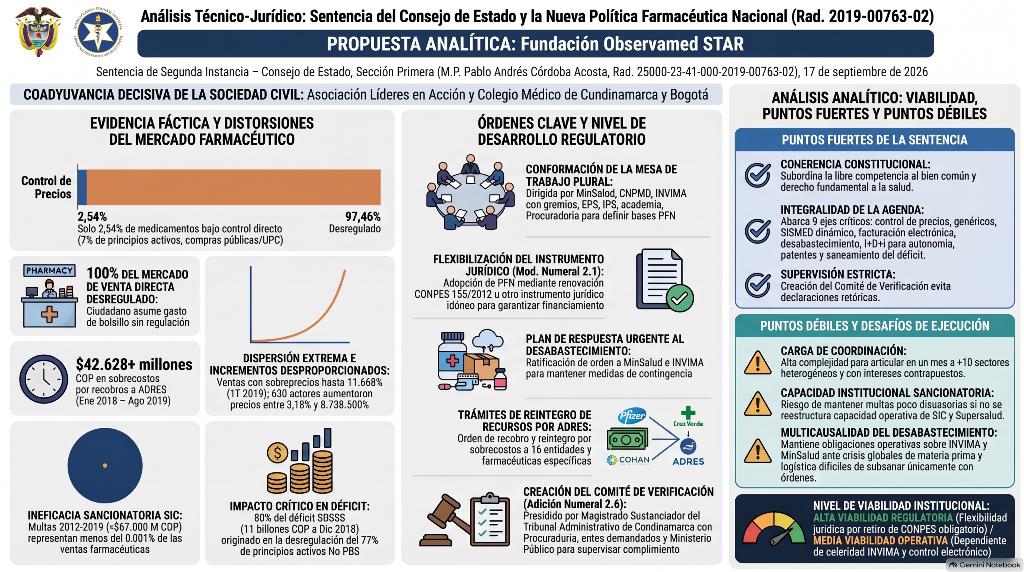
Analysis by Fundación Observamed STARThe ruling in one image
Analysis by Fundación Observamed STAR. The figures on cost overruns and deregulation come from the Attorney General's Office (Procuraduría) lawsuit and the reports cited in the proceedings; the ruling does not treat all of them as proven.Download the full analysis (PDF) →
Order 2.1The nine topics the working group must study
Reformulate the price control policy for medicines and medical devices, guaranteeing access for the population; free competition is not an absolute right.
Analyze market regulation strategies: lower-priced generics, decentralized purchasing, reverse auctions or public procurement, and framework price agreements.
Create or strengthen a data system with the inventory and price of medicines; modeled on SISMED, it could be redesigned to be public, reviewable, and dynamic.
Implement the Electronic Invoicing Control System.
Concrete solutions against shortages, including strengthening INVIMA to issue marketing authorizations (registros sanitarios) in less time.
Design and implement the national policy on pharmaceutical research, development, innovation and production for health sovereignty.
Patents and industrial property: manual updates.
To evaluate the financing and deficit-remediation instruments of the health system (reimbursement claims, maximum budgets, the final-settlement agreement).
Schedule of meetings and activities.
Why it matters to the ObservatoryPrices, data and transparency
Public, reviewable and dynamic SISMED
One of the points the roundtable must study is an inventory and medicine price data system that, under the SISMED model, could be redesigned to be public, reviewable and dynamic (pp. 13, 72). It is the type of information the Medicines Observatory analyzes and publishes.
Reliable and public price information
The ruling recalls that the first strategy of the 2012 pharmaceutical policy sought reliable, timely and public information on prices, to address problems of transparency and information asymmetry (p. 48).
Reporting to SISMED is also a consumer right
The Chamber cites its own ruling of March 26, 2026, which protected consumers' rights in a case of failure to report data to SISMED (p. 36).
An ally of the Observatory took part in the process
The Medical College of Cundinamarca and Bogotá was admitted as a supporting party on March 13, 2024 (p. 11).
The starting pointWhat the lawsuit said
These are claims made by the Inspector General's Office (Procuraduría) in its lawsuit; the ruling does not deem them proven one by one.
2,5 %of medicines would have a maximum price applicable to purchases with UPC resources and recobros (pp. 4-5)
COP 42,628 millionin cost overruns on recobros paid by ADRES between January 2018 and August 2019 (p. 6)
2.645supervised (74% of those registered in SISMED) would have sold above the maximum price in the first quarter of 2019 (p. 6)
21 %of total health spending corresponds to medicines (p. 8)
How we got hereTimeline
CONPES 155: National Pharmaceutical Policy, valid for 10 years (pp. 8, 45)
Law 1751 (Statutory Health Law): Article 23 mandates a National Pharmaceutical Policy (p. 44)
The complaint filed by the Procuraduría is admitted (p. 10)
CONPES 155 ceases to be in force (pp. 45, 47)
Urgent precautionary measure and joinder of INVIMA (pp. 11, 38)
The Colegio Médico de Cundinamarca y Bogotá is accepted as a supporting party (p. 11)
First-instance ruling of the Administrative Tribunal of Cundinamarca (p. 12)
The Health Superintendency, MinSalud and INVIMA appeal; in March, the SIC joins the appeal (pp. 15, 18, 26, 28)
Second-instance ruling of the Council of State (Consejo de Estado): confirms, modifies and adds (pp. 1, 73)
The appealsWhat each entity argued
Entity
What was argued and what happened
Ministry of Health
Pharmaceutical policy instruments already exist; the policy should not be tied to a CONPES; the order on shortages exceeds the claim (pp. 18-25). Only the point about the instrument succeeded (p. 53).
INVIMA
It does not regulate prices nor is it solely responsible for the shortage; it was not sued from the outset (pp. 26-28). It did not succeed.
National Health Superintendency (Supersalud)
The ruling did not analyze its conduct; it has no authority to regulate prices (pp. 15-18). It did not succeed.
Superintendency of Industry and Commerce
The order repeats its legal functions and the claims were not directed against it (pp. 28-29). It did not succeed.
Observatory ReadingWhat the ruling gets right
Links pricing and supply
It treats medicine shortages and price speculation as a single problem, and gets INVIMA and the Price Commission working together.
It does not stay in the future
In addition to the new policy, it maintains specific orders for the SIC, the National Health Superintendency (Supersalud) and ADRES regarding overcharges already paid.
Opens the table to society
Patients, academia and civil society get a seat at the table in building the policy, not just the Ministry.
Observatory ReadingThe risks to its success
Paralysis by analysis
A roundtable with dozens of stakeholders with opposing interests can prolong discussions without timely decisions.
Capacity and budget
The orders demand more technical capacity from INVIMA, the SIC and the Superintendency, but the ruling does not allocate resources.
A problem with many causes
Shortages also depend on raw materials and global logistics, which court orders alone cannot resolve.
Observamed STAR ForecastHow feasible is it?
LegalHighThe orders rely on Statutory Law 1751 of 2015 and now have a committee that monitors compliance.
TechnicalMediumElectronic invoicing control and a dynamic SISMED require data infrastructure that does not exist today.
PolicyComplexResistance is expected over the renegotiation of margins, patents and the recovery of funds by ADRES.
What comes nextWhat remains to be fulfilled
Form the working group within the month following notification and inform the magistrate of its members (p. 72).
Set up the compliance verification committee (p. 73).
Management and progress reports from MinSalud to the presiding justice (p. 72).
The ruling does not state the date of notification; for that reason the dates of these deadlines cannot yet be set.
Case detailsProfile
Data point
Details
Corporation
Council of State (Consejo de Estado) · Administrative Litigation Chamber · First Section (p. 1)
Reporting Councilor
Pablo Andrés Córdoba Acosta; also signed by Carlos Fernando Mantilla Navarro and Nubia Margoth Peña Garzón (pp. 1, 73)
Date
September 17, 2026 (p. 1)
Filing number
25000-23-41-000-2019-00763-02 (p. 1)
Type of proceeding
Acción popular (public interest action): protection of collective rights and interests (p. 1)
Plaintiff
Office of the Inspector General (Procuraduría General de la Nación), Delegate Inspector for Health, Social Protection and Decent Work (pp. 1-2)
Defendants
Ministry of Health and Social Protection; Ministry of Commerce, Industry and Tourism; National Commission on Medicine and Medical Device Prices (CNPMD); National Health Superintendency; Superintendency of Industry and Commerce (p. 1)
Linked
INVIMA; in addition, the Tribunal included ADRES and the Office of the Comptroller General of the Republic (pp. 1, 10-11)
Adjuvants
Asociación Líderes en Acción, Colegio Médico de Cundinamarca y Bogotá and AFIDRO (pp. 10-11)
What it decides
The appeals by MinSalud, INVIMA and the National Health Superintendency (Supersalud), and the adhesive appeal by the SIC, against the ruling of the Administrative Court of Cundinamarca of December 12, 2024 (p. 1)
Key words of the caseGlossary
Term
What it means
Acción popular (public interest action)
A judicial mechanism to protect the rights of the entire community; any person or entity may bring it (pp. 32-33).
First and second instance
The Tribunal ruled first; the Council of State (Consejo de Estado) reviews the points under appeal (pp. 1, 30).
Confirm, modify, add
Maintain, change, or add parts of the appealed ruling (pp. 71-73).
CNPMD
National Commission on Medicine and Medical Device Prices (CNPMyDM): sets price regulation policy (pp. 37, 67).
SISMED
Medicine price information system (pp. 6, 13, 36, 72).
CONPES
Document of the National Council for Economic and Social Policy that sets out a public policy; it is coordinated by the DNP (pp. 53-55).
Recobro (reimbursement claims)
Billing ADRES for medicines not included in the Benefits Plan (pp. 5, 7).
Verification committee
A mechanism under Law 472 of 1998 that monitors compliance with the ruling (pp. 70, 73).
Summary prepared by the Medicines Observatory based on the text of the ruling. The pages in parentheses refer to the original document, which can be downloaded in full: Second-instance ruling (PDF, 73 pages). This summary is informational and does not replace reading the decision or constitute legal advice. Last updated: October 21, 2026.
Medicines Observatory ISSN 0121-4675 · Res. Min. Gobierno 0036/91 Year 36 · 1991–2026
Disclaimer. The information published here is provided as a service to health professionals and their patients. It is in no way intended to suggest treatments or to replace the doctor-patient relationship. No staff member of Fundación Observamed STAR, Med-Informática Editores S.A.S. or Medicentro AR S.A.S. can accept any responsibility for improper use of the information published on these pages.